
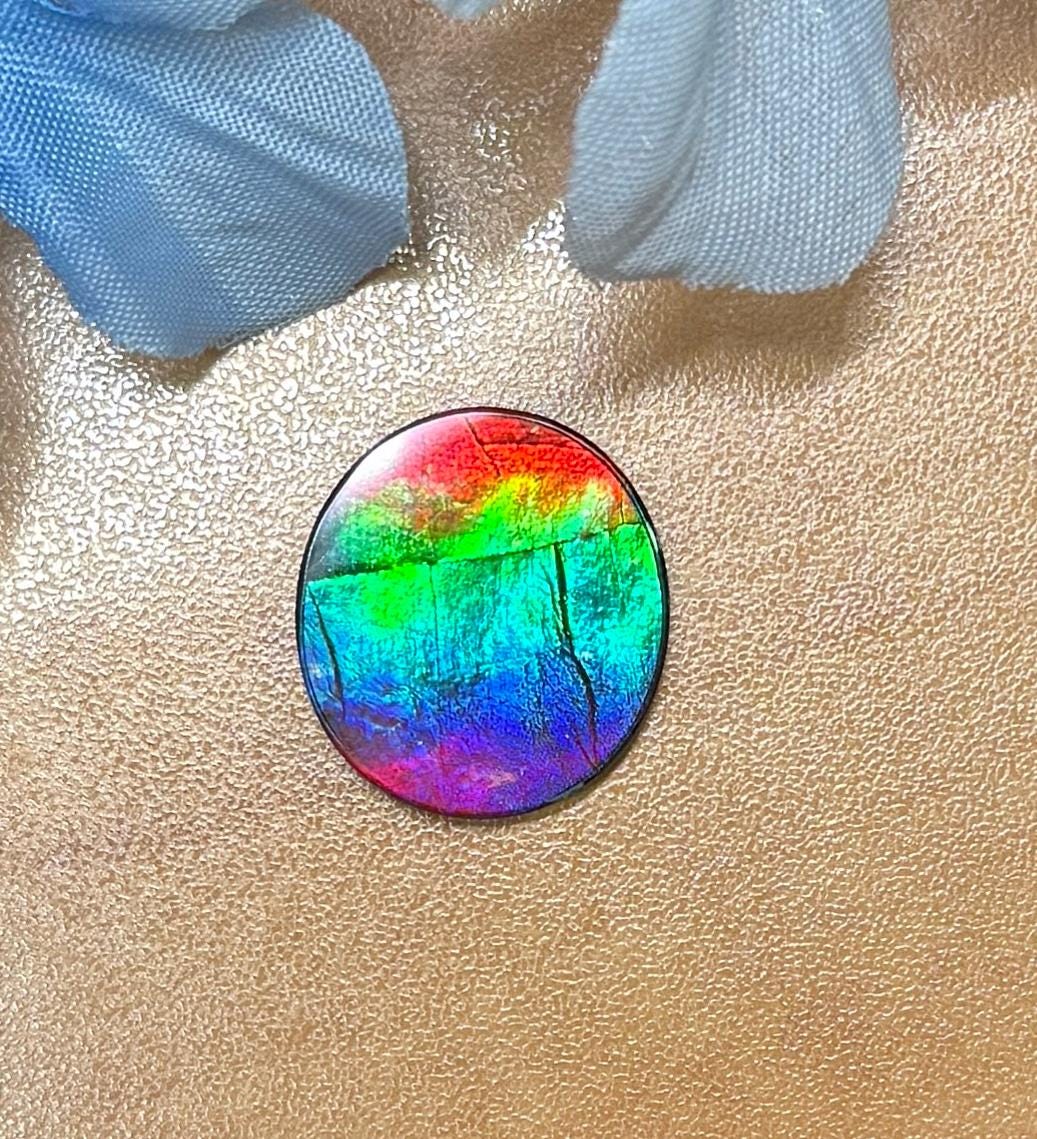
A practical buyer’s checklist for jewelers and makers: grade, colour coverage, form, rotational range, matching pairs, and which loose Canadian Ammolite stones set well. If you make jewelry — or buy stones for clients who do — loose Ammolite is a different purchase than a finished pendant. You are not only buying colour. You are buying a stone that has to survive setting, sit correctly in a bezel or custom mount, and still show fire after the piece is worn.
Canadian Ammolite is rare, soft, and often assembled. The right stone saves hours at the bench. The wrong one chips, dulls, or disappears once the metal goes around it. This guide is written for jewelers, production setters, and makers who buy loose stones. What you are actually buying Gem-quality Ammolite is the iridescent layer from fossilized ammonite shell, found commercially in southern Alberta’s Bearpaw Formation. That colour layer is thin — often a fraction of a millimeter — and relatively soft (about 3.5–4.5 on the Mohs scale). Because of that, loose Ammolite usually arrives in one of three forms:
- Natural — polished colour layer left on its original shale backing, no quartz cap
- Doublet — colour layer bonded to a backing (often shale or a dark substrate)
- Triplet — backing + Ammolite + a clear cap of quartz, synthetic spinel, or similar
If you are choosing stones for rings or daily-wear pieces, construction matters as much as grade. Read the guide: Natural vs Doublet vs Triplet: A Setter’s Guide.
The buyer’s checklist
- Colour count and rarity — Red and green are common; blue, violet, gold, and crimson are scarcer. For jewelry that has to sell at a glance, look for two strong colours on mid-grade stones and three or more vivid colours on AA / AAA. Colour should stay bright when the stone is tilted, not only at one sweet spot.
- Brightness — This often matters more than size. Two stones can share colours and have very different value. Ask for photos plus a short video under daylight and warm indoor light, with a tilt through 180 degrees.
- Rotational range — The angle over which colour stays visible. Weak-range stones are harder to set and harder to sell. For earrings, matched behaviour when both stones tilt the same way matters as much as matched hue.
- Face coverage and matrix — Matrix lines are common and not automatically a defect. They become a problem when they cut through the centre of a small cab, sit under a prong, or make a pair look unmatched.
- Shape, profile, and thickness — Measure length × width of the colour face, total thickness (backing and cap), dome height on triplets, and whether the back is flat enough for a standard bezel. Do not assume carat weight equals usable face. Freeforms need custom bezels; calibrated shapes save labour.
- Grade at the bench — Letter grades are useful shorthand, not a GIA-style lab system. AAA for signature pieces; AA for strong commercial work; A for accessible lines; Standard for accents and budget work. Grade does not replace construction. An A-grade triplet can outperform an AAA natural in a ring because the cap protects the colour layer.
- Stability and disclosure — Stabilization and assembly are normal. You want form (natural / doublet / triplet), cap material if capped, stabilization, and Alberta origin. Check the profile with a loupe. A triplet shows a clear dome with no play-of-colour in the cap itself.
Matching pairs — Check dominant colours, brightness, pattern scale, and tilt behaviour. If you cannot get a true pair, design around related freeforms rather than forcing a mismatch.