
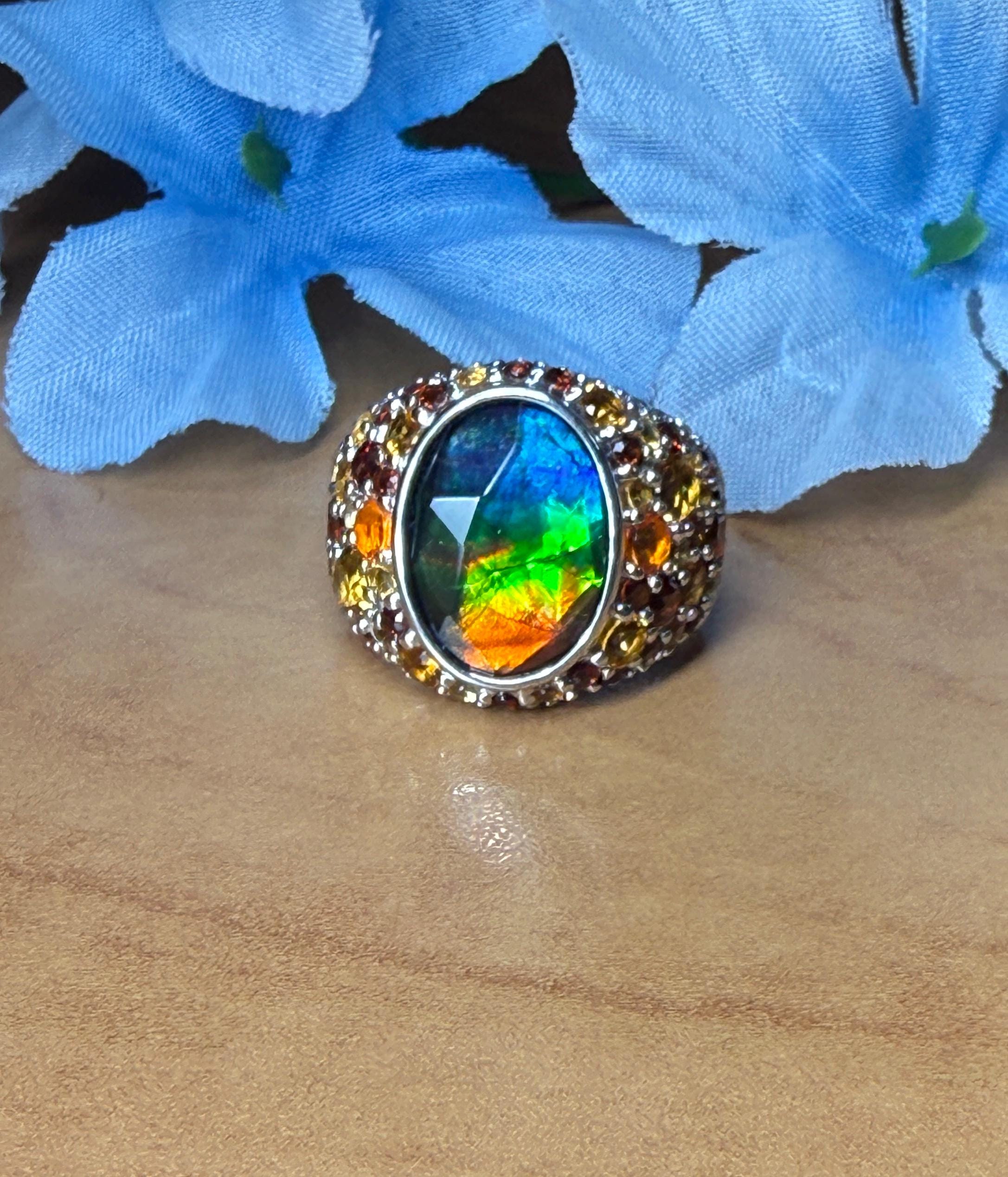
How natural, doublet, and triplet Ammolite differ at the bench: durability, heat, bezels vs prongs, rings vs pendants, and which form to buy for the jewelry you are making. Most arguments about Ammolite durability are really arguments about construction. The iridescent layer that makes Canadian Ammolite valuable is thin and soft. Jewelers who treat every cab like a hard gem lose stones. Jewelers who match form to the job get wearable colour without surprises at the bench. Natural — Colour face on original shale, no cap.
Most organic look; freeform shapes; soft top surface. Best for pendants, earrings, brooches. Heat, solvents, and vibration are hostile. Doublet — Colour layer bonded to a backing. More settable thickness; top still exposed and scratchable. Glue line fails if you overheat. Closed bezels beat tall exposed prongs. Triplet — Backing + colour + clear cap (optical quartz or synthetic spinel; glass on cheaper goods). Cap raises surface hardness and acts as a shallow lens. Best default for rings and higher-contact jewelry. Still assembled: heat and ultrasonic can attack the bonds. Disclose as an assembled stone — that is standard, not a fake.
How to tell them apart — Look at the profile. Natural: colour to the top. Doublet: join line, gem on top. Triplet: colourless dome with no fire in the cap. Setting rules
- Set after soldering whenever you can.
- Do not assume a cap can take a torch. The cap handles abrasion; the cement does not handle heat.
- Full or partial bezel is the default for uncapped stones.
- Prongs can work on well-made triplets if the seat is right and prongs do not bite a thin girdle.
- No ultrasonic or steam on any form. Soft damp cloth only. Last on, first off for perfume and chemicals.
What to stock
- Custom pendant work: naturals and better doublets.
- Production earrings/rings: calibrated triplets.
- Dual retail + loose: label form on every listing. AAA natural and AAA triplet are not the same product.
Common mistakes — Buying on grade alone; putting a natural in an exposed ring; overheating assembled stones during sizing; treating glass caps like quartz caps.